What tree pruning involves
Pruning is selective cutting to make a tree safer, smaller, lighter or better shaped, while keeping it. In many Chelmsford gardens the problem isn’t the tree itself but its size: branches scraping the roof, a crown blocking light, or growth over a neighbour’s garden. Careful pruning deals with that and keeps the privacy, shade and wildlife value a mature tree provides.
Good tree surgeons work to British Standard BS 3998 (Tree work: Recommendations), and the Planning Portal notes councils usually expect work on protected trees to follow it. That means cutting back to suitable points so the tree can seal its wounds and regrow in balance. Hacking a tree back to stumps (topping) tends to cause dense, weakly attached regrowth and decay.
| Work | What it involves | Typically used for |
|---|---|---|
| Crown reduction | Reducing height and spread by shortening branches to suitable growth points. | Trees that have outgrown their space; reducing load. |
| Crown thinning | Removing a proportion of smaller inner branches without changing the outline. | More light through the canopy; less wind resistance. |
| Crown lifting | Removing lower branches to raise the crown to a set height. | Clearance over lawns, paths, drives and roads. |
| Deadwooding | Removing dead, dying or broken branches. | Safety over patios, paths and play areas. |
| Formative pruning | Light pruning of young trees to build a good structure. | Newly planted and young trees. |
| Pollarding | Cutting back to the same points on a regular cycle. | Trees that have been pollarded before. |
Fruit trees in gardens are pruned on different principles (for fruiting rather than size), so mention it if that’s what you need.
When you need it: signs to look for
- Branches touching or overhanging the roof, gutters, windows or a conservatory.
- A garden or room that has become noticeably darker as the tree has grown.
- Dead, snapped or hanging branches, especially over paths or play areas.
- Low branches over a drive, pavement or road. Essex Highways asks owners to keep 2.4m clear over pavements and cycleways and 5.1m over roads (Essex Highways (opens in a new tab)).
- Branches rubbing against each other, or a tree that is lopsided after storm damage.
- Growth close to overhead lines. Don’t prune near them yourself; UK Power Networks can arrange a visit (UKPN (opens in a new tab)).
The process with a tree surgeon
- Say what you want to achieve: “more light in the kitchen”, “branches off the roof”, “keep it at this height”. That helps the tree surgeon recommend the right type and amount of pruning.
- Assessment and specification. A clear spec might read “reduce crown height and spread by about 2m, remove deadwood over the patio”, not just “cut back”.
- Permissions. If the tree is protected, the specification forms the basis of an application or notice to Chelmsford City Council.
- Timing. The work is booked for a suitable season for the species, and the tree is checked for nests and bats beforehand.
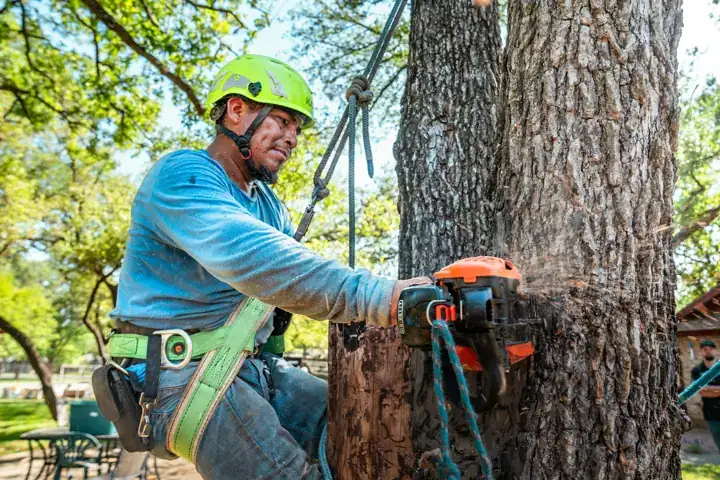
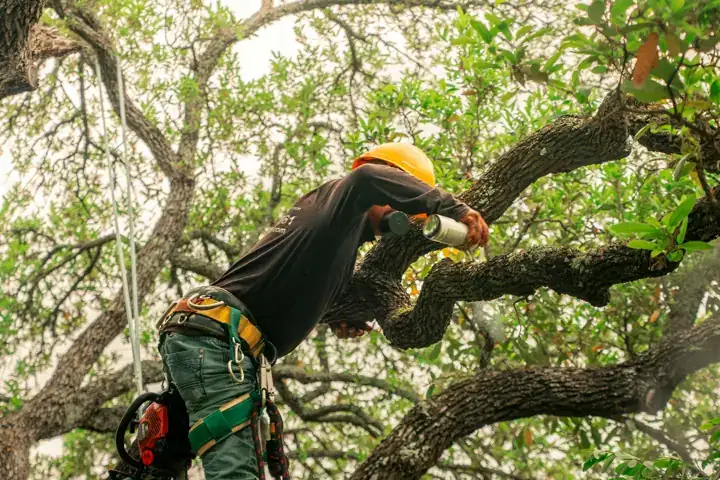
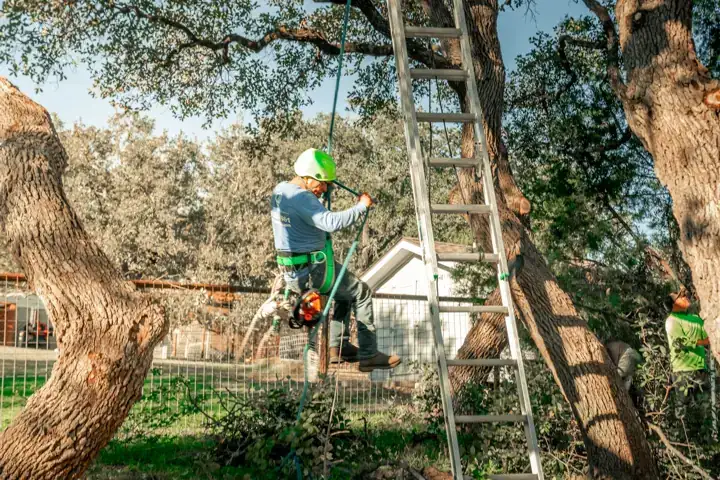
- The work. Usually a climber on ropes, sometimes a platform, with a ground worker chipping brash.
- Clear-up and removal of arisings, or logs left if you want them.
What affects a pruning quote
- The type and amount of work: a light deadwood is quicker than a full crown reduction.
- Tree size, species and condition.
- Access for climbers and for moving brash to the chipper.
- Targets below: roofs, glasshouses, a road or overhead cables.
- Whether several trees are done in one visit.
- Whether arisings are taken away or logs left on site.
Safety, permissions and timing
Protected trees
Chelmsford City Council says a tree is protected if it has a Tree Preservation Order (TPO) or stands in a conservation area; conservation-area trees more than 7.5cm in diameter at 1.5 metres above the ground are protected as if they had a TPO. You normally need the council’s consent (TPO trees) or must give six weeks’ notice (conservation-area trees) before work. Check the council’s TPO register (opens in a new tab) or read our TPO and conservation area guide.
The Planning Portal says there is no fee for a works-to-trees application, TPO decisions can take up to eight weeks, and consent lasts two years (Planning Portal (opens in a new tab)).
Nesting birds and bats
Under the Wildlife and Countryside Act 1981 it is an offence to intentionally take, damage or destroy a wild bird’s nest while it is being built or in use, and all bat species and their roosts are protected. GOV.UK says offences can bring an unlimited fine and up to six months in prison. The RSPB describes March to September as the main nesting season. See our nesting birds and bats guide.
Species timing
The RHS advises routine pruning of plums, cherries and other silver-leaf-susceptible trees in summer, as infectious spores are active from September to May (RHS silver leaf (opens in a new tab)). Trees prone to bleeding sap, including birch, walnut and maple, are best pruned while fully dormant, as they bleed if cut in mid to late winter or early spring (RHS bleeding (opens in a new tab)). Dangerous branches can be dealt with at any time.
Questions to ask a tree surgeon
- What exactly will you cut, and by how much? Can you write that in the quote?
- Do you prune to BS 3998 recommendations?
- Is this a good time of year for this species?
- Is the tree protected, and will you prepare the application or notice?
- Can I see your insurance and NPTC certificates?
- How often is this likely to need doing again?
Be wary of anyone who offers to “top” a tree or can’t explain what they’ll cut. See the Arboricultural Association (opens in a new tab) for more on choosing a contractor.
Local notes for Chelmsford, Essex
Chelmsford’s older streets and villages have plenty of mature trees in small gardens, which is where reductions and thinning make the most sense. In Writtle, Great Baddow, Broomfield, Danbury, Moulsham Street, Springfield Green and the city’s other conservation areas, even pruning usually needs notice to the council, so allow time. On newer estates such as Beaulieu, young trees benefit from formative pruning early, which is cheaper and gentler than a big reduction later.
Would you like a free quote?
Tell us about the job and we’ll pass it to an independent local tree surgeon covering your part of Chelmsford.
Frequently asked questions
What is the difference between crown reduction and crown thinning?
A crown reduction makes the whole tree smaller by shortening branches back to suitable growth points. Crown thinning keeps the size the same but removes a proportion of smaller inner branches, letting more light and wind through.
What is crown lifting?
Crown lifting removes or shortens the lowest branches to give clearance above a lawn, path, drive or road. Essex Highways asks owners to keep 2.4m clear over pavements and 5.1m over roads.
How much can be taken off a tree?
It depends on the species, age and health of the tree. Good practice (set out in British Standard BS 3998) is to avoid removing more than the tree can tolerate. Heavy, indiscriminate cutting (“topping”) usually causes weak regrowth and decay. The tree surgeon will recommend a sensible amount.
When is the best time to prune trees?
Many deciduous trees are pruned while dormant. The RHS advises pruning plums and cherries in summer to reduce the risk of silver leaf, and pruning trees prone to bleeding sap, such as birch and maple, while fully dormant rather than in late winter. See our winter tree work guide.
Can I prune branches overhanging from my neighbour’s tree?
Generally you can cut back to your boundary if the tree isn’t protected, you don’t go onto their property, and you don’t disturb nesting birds or bats. Our neighbour’s trees guide explains the details.
Do I need permission to prune a tree with a TPO?
Yes. Pruning a tree covered by a Tree Preservation Order normally needs consent from Chelmsford City Council, and trees in conservation areas need six weeks’ notice. The Planning Portal says there is no fee for these applications. Read our TPO guide.
Will pruning stop my tree blocking light?
Often it helps a lot. A crown reduction or thinning can let noticeably more light into a garden or house while keeping the tree. Crown lifting helps if the problem is low branches.