Quick facts: timing tree work
- Dormant season
- Many deciduous trees and shrubs are best pruned while dormant, when bleeding is minimised (RHS).
- Plums, cherries & Prunus
- Prune in summer: silver leaf spores are active September to May (RHS).
- Bleeding-prone trees
- Birch, walnut, maple, hornbeam, laburnum, magnolia, mulberry, poplar, lime: prune while fully dormant, not mid to late winter or early spring (RHS).
- Nesting season
- Main season March to September; hedge cutting recommended 1 September to 28 February, still checking for nests (RSPB).
- Protected trees
- Allow six weeks (conservation area) or eight weeks (TPO) for Chelmsford City Council.
- Dangerous trees
- Deal with them whenever needed. Don’t wait for winter.
Checked 27 September 2026 against: RHS: bleeding from pruning cuts (opens in a new tab); RHS: silver leaf (opens in a new tab); RSPB (opens in a new tab); Chelmsford City Council (opens in a new tab). Details can change, so confirm on the official page before you rely on them.
Who this guide is for: Chelmsford, Essex homeowners deciding when to book pruning, reductions, removals or hedge work, and anyone unsure whether their tree should be cut in winter or summer.
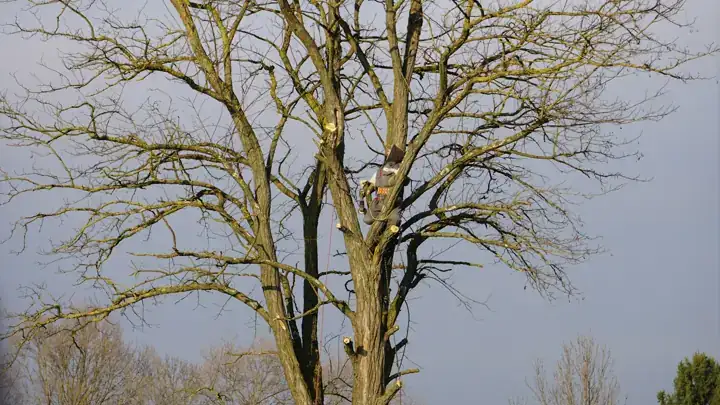
Why so much tree work happens in winter
For deciduous trees such as oak, ash, lime, sycamore, beech and apple, the dormant season has real advantages:
- You can see the structure. With the leaves off, the branch framework, deadwood, cavities and weak unions are clear, so cuts can be better placed.
- Less bleeding. The RHS says many deciduous trees and shrubs are best pruned while dormant, when bleeding is minimised (RHS (opens in a new tab)).
- Outside the main nesting season. The RSPB describes March to September as the main nesting season, so winter work carries less risk of disturbing active nests.
- Less leaf to handle. Less material to chip and move, and borders are dormant. Ground protection is still used on soft lawns.
- Ready for spring. A reduction done in winter gives the tree the spring to respond, and you get the extra light straight away.
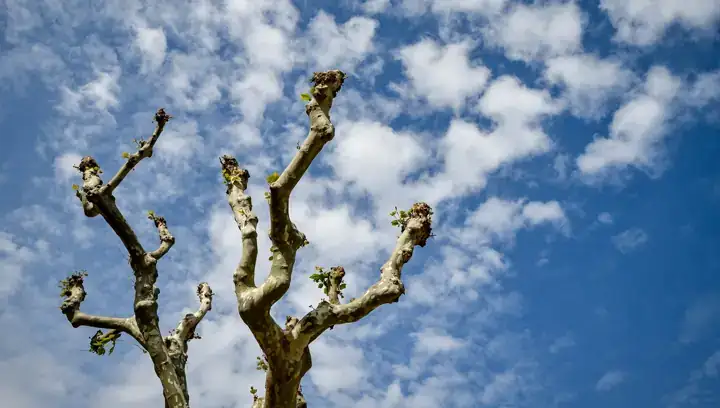
Exceptions: trees that shouldn’t be pruned in winter
- Plums, cherries and other Prunus. The RHS says silver leaf infects mainly through pruning wounds and its spores are active from September to May, so routine pruning of susceptible plants is ideally done in summer, when wounds also heal faster. It lists plums, apples, apricots, cherries, hawthorns and poplars among trees most commonly affected (RHS silver leaf (opens in a new tab)).
- Trees that bleed sap. The RHS lists birch, walnut, maple, hornbeam, laburnum, magnolia, mulberry, poplar and Tilia. Sap rises early in some, such as birch and walnut, making them particularly vulnerable if pruned in mid to late winter or early spring, so they’re best pruned while fully dormant (RHS bleeding (opens in a new tab)).
- Evergreen hedges and conifers are commonly trimmed in late summer and early autumn, after the main nesting period. See hedge trimming.
- Dangerous trees should be made safe whenever needed. See emergency and storm-damaged trees.
Nesting birds and bats
Active nests are protected all year under the Wildlife and Countryside Act 1981, and all bats and their roosts are protected too. Winter work reduces the risk to nesting birds, but bats can use trees in any season, so mature trees with cavities or loose bark still need checking. Our nesting birds and bats guide explains the law and the RSPB’s advice.
Planning winter work in Chelmsford, Essex
- Enquire in early autumn. Tree surgeons can get busy through the dormant season, especially after the first storms.
- Check protection early. Chelmsford City Council usually decides within six weeks for conservation-area trees and eight weeks for TPO trees (council (opens in a new tab)). See our TPO guide.
- Think about access. Wet winter ground can make lawns soft. Ask how the tree surgeon will protect it.
- Expect weather delays. High winds, ice and snow can postpone climbing work.
- Plan the waste. Winter reductions still produce a lot of brash. See our garden waste guide.
Common winter jobs
The dormant season suits tree removal and felling, crown reductions and thinning of many broadleaved trees, hard renovation of overgrown deciduous hedges, and stump grinding ahead of spring planting.
Frequently asked questions
Is winter the best time to prune trees?
For many deciduous trees, yes. The RHS says many deciduous trees and shrubs are best pruned while dormant, when bleeding is minimised. But there are important exceptions, such as plums and cherries, which the RHS advises pruning in summer.
Why shouldn’t cherries and plums be pruned in winter?
The RHS says silver leaf fungus infects through wounds, mainly pruning cuts, and its infectious spores are active from September to May, so routine pruning of susceptible trees is ideally done in summer, when wounds also heal more quickly.
Which trees bleed sap if pruned at the wrong time?
The RHS lists birch, walnut, maple, hornbeam, laburnum, magnolia, mulberry, poplar and lime (Tilia) among plants affected. Those whose sap rises early, such as birch and walnut, are particularly vulnerable if pruned in mid to late winter or early spring.
Can tree work be done in frost or snow?
Tree surgeons may postpone work in severe frost, snow, ice or high winds for safety, as climbing and ground conditions become hazardous. A flexible date helps.
Is winter outside the nesting season?
Largely. The RSPB describes March to September as the main nesting season and recommends hedge cutting between 1 September and 28 February, while still checking, because some birds nest early.
How far ahead should I book winter work?
If the tree is protected, allow for Chelmsford City Council’s usual six weeks (conservation area) or eight weeks (TPO) before work can start. Tree surgeons can also be busy after storms, so an early enquiry helps.
Sources
All checked 27 September 2026. We link to the official page rather than repeat details that change often.
Need a tree surgeon?
If you’d like a free quote, we can pass your enquiry to an independent local tree surgeon in Chelmsford. Related services:
- Pruning & crown reductionCrown reduction, thinning, lifting and deadwood removal to keep a tree healthy and in proportion.
- Tree removal & fellingStraight felling where there’s room, or section-by-section dismantling in tight Chelmsford gardens.
- Hedge trimming & cuttingRegular trims, height reductions and overgrown hedges and conifer screens brought back under control.
Related guides
- Nesting birds, bats & tree workWhat the Wildlife and Countryside Act means for tree and hedge work, nesting season advice and bat roosts.
- TPOs & conservation areasHow to check if a tree is protected in Chelmsford, how to apply, timescales and dead or dangerous trees.
Get a free, no-obligation quote
Tell us about the job and we’ll pass it to an independent local tree surgeon covering your part of Chelmsford.